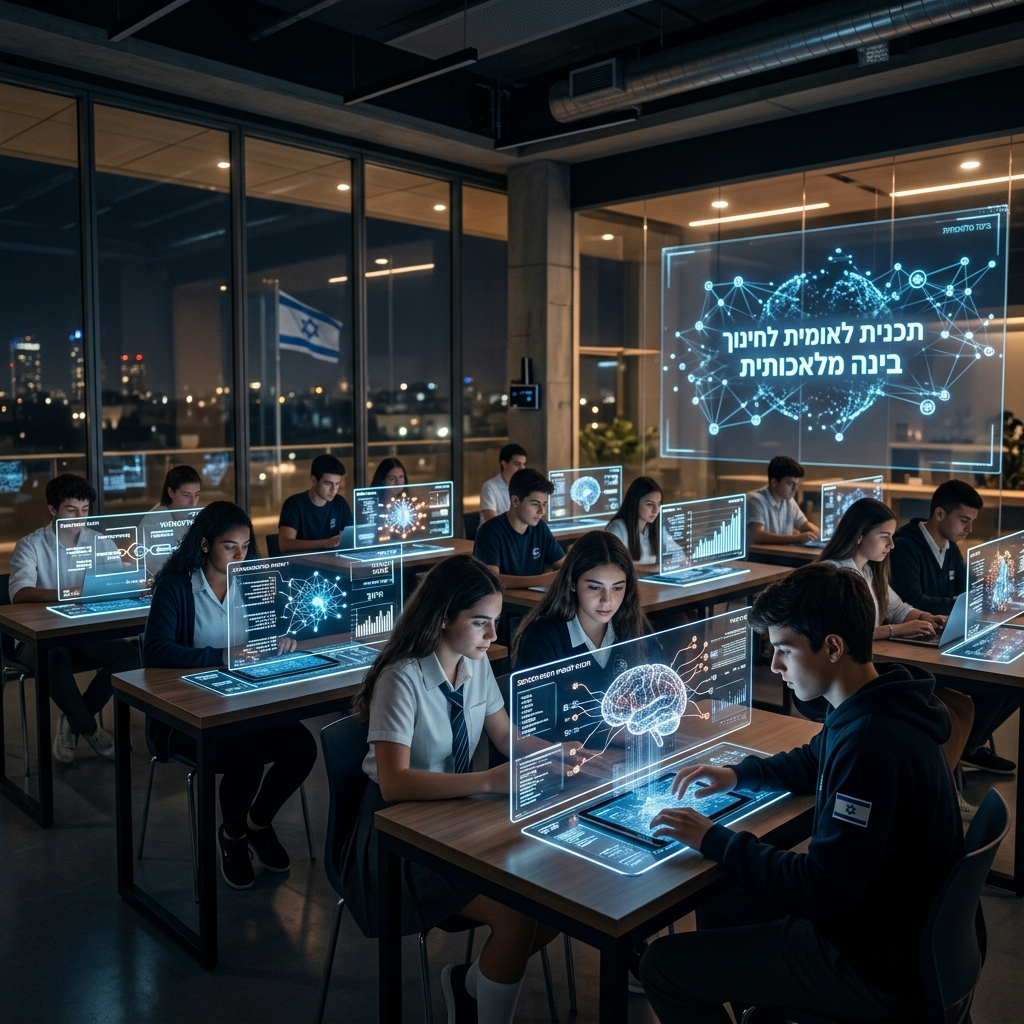
The Israeli government has announced a landmark NIS 1.1 billion ($300 million) allocation to integrate artificial intelligence across the country’s entire education system — from elementary schools through high school — in what officials are calling the most ambitious national AI education initiative in the world.
The Plan at a Glance
| Component | Details |
|---|---|
| Total Investment | NIS 1.1B (~$300M) |
| Timeline | 2026–2030 |
| Schools Covered | All K-12 public schools |
| Teacher Training | 50,000+ educators |
| Curriculum Scope | AI literacy, coding, ethics, applied AI |
| Industry Partners | Intel, NVIDIA, Check Point, Mobileye |
What Students Will Learn
The curriculum is structured in three progressive tiers:
Elementary (Ages 6-12)
- Computational thinking fundamentals
- Introduction to machine learning concepts through visual, game-based tools
- AI ethics basics — fairness, bias, and privacy explained at age-appropriate levels
- Using AI assistants as learning aids (guided, supervised)
Middle School (Ages 12-15)
- Python programming with AI/ML libraries
- Data science fundamentals — collecting, cleaning, and analyzing data
- Building simple machine learning models (classification, prediction)
- Critical evaluation of AI outputs — identifying hallucinations, bias, and limitations
High School (Ages 15-18)
- Deep learning and neural network architecture
- Applied AI projects — robotics, computer vision, NLP
- AI policy and governance — regulation, workforce impact, international competition
- Research methodology — designing and conducting AI experiments
- Advanced elective: AI entrepreneurship
Why Israel Is Moving First
Israel’s decision reflects several strategic imperatives:
- Economic competitiveness: Israel’s tech sector accounts for ~18% of GDP, and AI talent is critical to maintaining that position
- Military applications: The Israeli Defense Forces are among the world’s most AI-intensive military organizations
- Startup ecosystem: Israel produces more AI startups per capita than any other nation, and the pipeline depends on early technical education
- Brain drain prevention: Without competitive education, top talent migrates to the US and Europe
Industry Partnerships
The plan includes deep integration with Israel’s tech sector:
- Intel will provide curriculum content on chip design and edge AI
- NVIDIA will supply educational GPU clusters for school AI labs
- Check Point will develop cybersecurity and AI safety modules
- Mobileye will create autonomous systems and computer vision coursework
- Local startups will offer mentorship and project sponsorship
Teacher Training
Perhaps the most ambitious component: the plan calls for training over 50,000 educators in AI fundamentals within three years. The training program includes:
- 120-hour certification courses for math and science teachers
- Dedicated AI teaching specialists hired for each school district
- Ongoing professional development with industry expert rotations
- AI-powered teaching assistant tools to help educators manage personalized learning
Global Context
Israel’s initiative is the most comprehensive national AI education plan to date, but it’s not alone:
| Country | AI Education Initiative |
|---|---|
| Israel | $300M, K-12 mandatory |
| Singapore | AI literacy in all secondary schools |
| UAE | AI university + K-12 programs |
| Finland | ”Elements of AI” — free national course |
| China | AI curriculum in select cities |
| US | Fragmented, state-level efforts |
The Bigger Picture
Israel’s $300M bet on AI education is a calculated wager on the future workforce. In a world where AI is reshaping every industry, the countries that produce AI-literate graduates at scale will have a structural advantage. By making AI education universal rather than elective, Israel is attempting to ensure that AI literacy becomes as fundamental as reading and mathematics.
Source: Jerusalem Post, Times of Israel, Globes