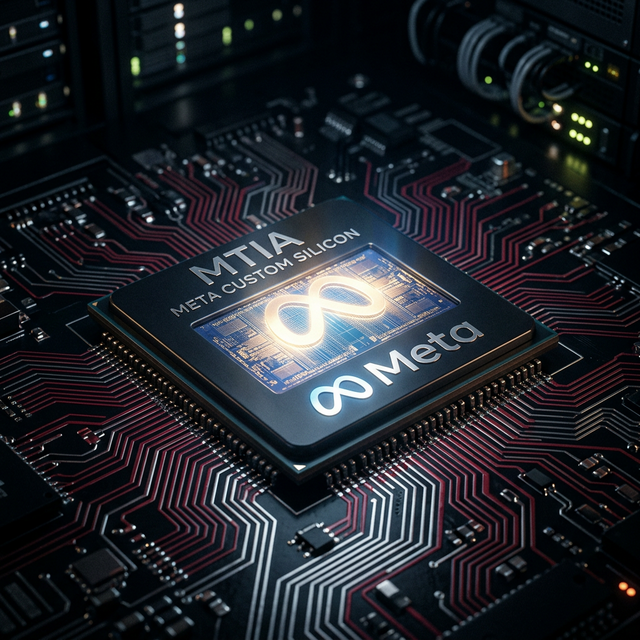
Meta’s dependence on Nvidia hardware has been one of the most significant cost and supply-chain risks facing the company’s AI ambitions. Its new MTIA chip roadmap — covering four generations in a single announcement — is the most aggressive move yet to change that.
The MTIA Family
Meta revealed:
- MTIA 300 — optimised for content ranking and recommendation, currently in active deployment
- MTIA 400 — a step-up for inference-heavy generative AI workloads
- MTIA 450 — a mid-cycle refresh targeting efficiency improvements across both content and generative tasks
- MTIA 500 — the flagship next-generation chip, slated for mass deployment in 2027, designed to handle trillion-parameter model inference at data-centre scale
The announcement covers what Meta describes as a “full-stack custom silicon strategy” — designing chips in-house from the ground up rather than adapting general-purpose Nvidia hardware.
Why Custom Silicon?
The economics are straightforward. At Meta’s scale, where AI serves billions of users across Instagram, Facebook, Threads, WhatsApp, and its advertising infrastructure, even modest efficiency gains on custom silicon translate to hundreds of millions in savings annually.
Beyond cost, there are strategic advantages:
- Latency — custom chips optimised for specific AI tasks can deliver lower-latency responses than general-purpose accelerators
- Supply independence — reducing reliance on Nvidia frees Meta from the allocation constraints and pricing power that have affected AI companies throughout the current boom
- Competitive moat — proprietary hardware prevents competitors from replicating Meta’s AI infrastructure performance simply by purchasing the same chips
What This Means for Nvidia
Meta’s MTIA roadmap does not represent an immediate threat to Nvidia’s dominance — H100s and Blackwell chips will remain central to training workloads for the foreseeable future. But for inference at scale, custom silicon from hyperscalers like Meta, Google (TPUs), and Amazon (Trainium/Inferentia) represents a growing displacement of Nvidia revenue.
Source: devflokers.com, buildez.ai