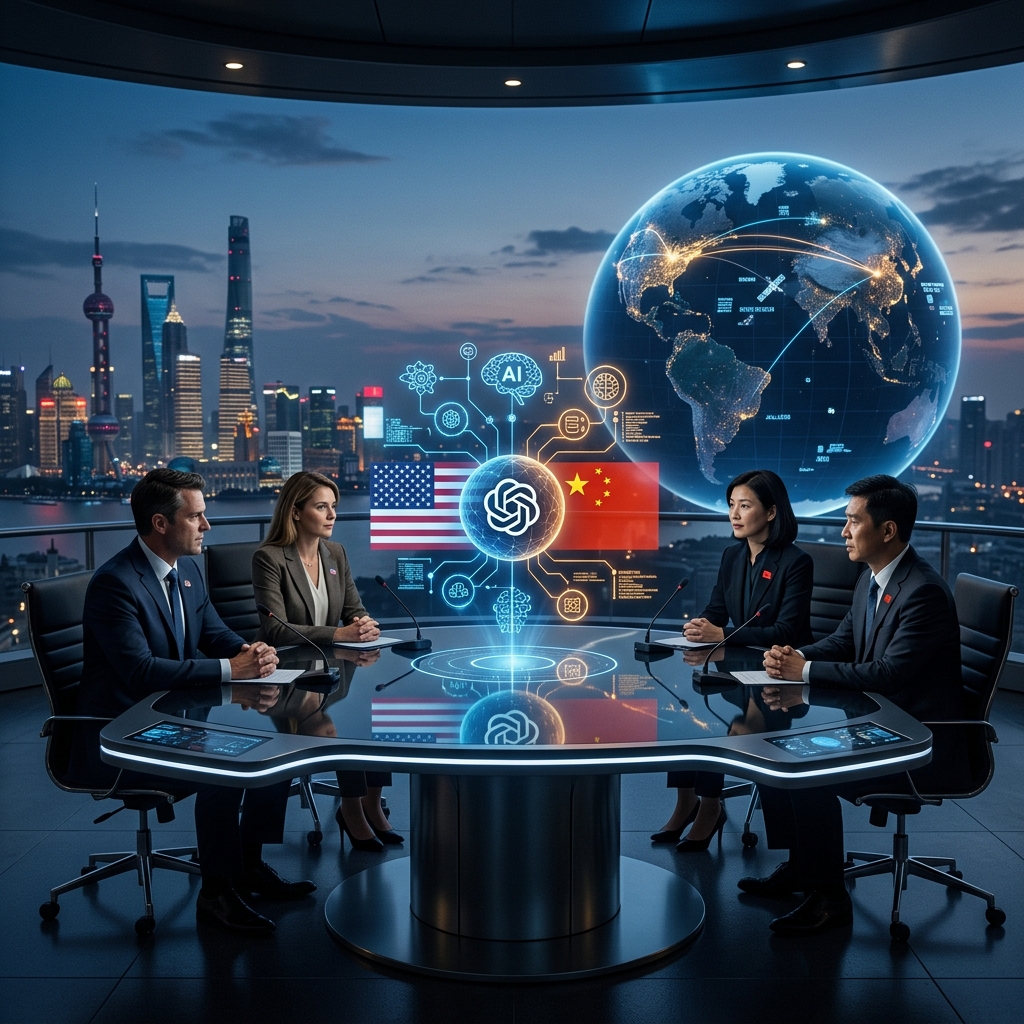
In a significant policy shift, OpenAI has publicly endorsed the creation of a global AI governance body that would include both the United States and China — a stance that arrives just days before a high-stakes Trump-Xi summit in Beijing.
The Proposal
OpenAI’s position, outlined in a policy brief published May 13, calls for:
- A multilateral AI safety organization modeled loosely on the International Atomic Energy Agency (IAEA)
- Shared red lines on AI applications in bioweapons development, cyberattacks on critical infrastructure, and fully autonomous weapons
- Mutual transparency protocols for frontier model capabilities exceeding defined thresholds
- Joint incident response mechanisms for AI-related crises
- A rotating leadership structure to prevent any single nation from dominating the body
Why Now?
The timing is deliberate. The upcoming Trump-Xi summit is expected to address AI competition as a central agenda item, alongside trade and Taiwan. OpenAI’s intervention is designed to frame the conversation around cooperation on catastrophic risks rather than purely competitive dynamics.
“The risks of advanced AI systems — in biological weapons, cyber offense, and autonomous targeting — are too severe for any nation to manage alone. A shared governance framework isn’t idealism. It’s risk management.” — OpenAI Policy Brief, May 13, 2026
Industry Reactions
The proposal has drawn both support and criticism:
Supporters:
- Anthropic issued a statement calling the proposal “directionally correct”
- DeepMind expressed willingness to participate in transparency protocols
- The EU AI Office called it “consistent with the AI Act’s international cooperation provisions”
Critics:
- Hawkish US lawmakers warned against sharing any AI safety research that could benefit Chinese military programs
- Chinese state media expressed skepticism about a framework that might restrict China’s AI development
- Some open-source advocates worry the framework could be used to limit access to model weights
The Geopolitical Context
The AI governance debate sits at the intersection of several competing pressures:
| Factor | US Position | China Position |
|---|---|---|
| Military AI | Maintain superiority | Close the gap |
| Commercial AI | Protect IP and market share | Expand domestic capacity |
| Safety standards | Voluntary industry commitments | Government-directed controls |
| Open source | Mixed — some support, some restriction | Increasing openness (DeepSeek, Qwen) |
| Bioweapons risk | Mutual concern | Mutual concern |
The areas of mutual concern — particularly bioweapons and cyberattacks — are where a governance framework has the highest chance of success. Both nations face the same nightmare scenario: a non-state actor using AI to develop weapons of mass destruction.
What Happens Next
The Trump-Xi summit is expected to produce, at minimum, a joint statement on AI safety cooperation. Whether it leads to a formal institutional framework remains uncertain, but the fact that major AI companies are publicly advocating for one represents a meaningful shift in the discourse.
For the industry, the key question is whether governance will accelerate or constrain AI development. OpenAI is betting that clear rules of the road will actually increase investment by reducing regulatory uncertainty.
Source: Financial Post, Taipei Times, OpenAI