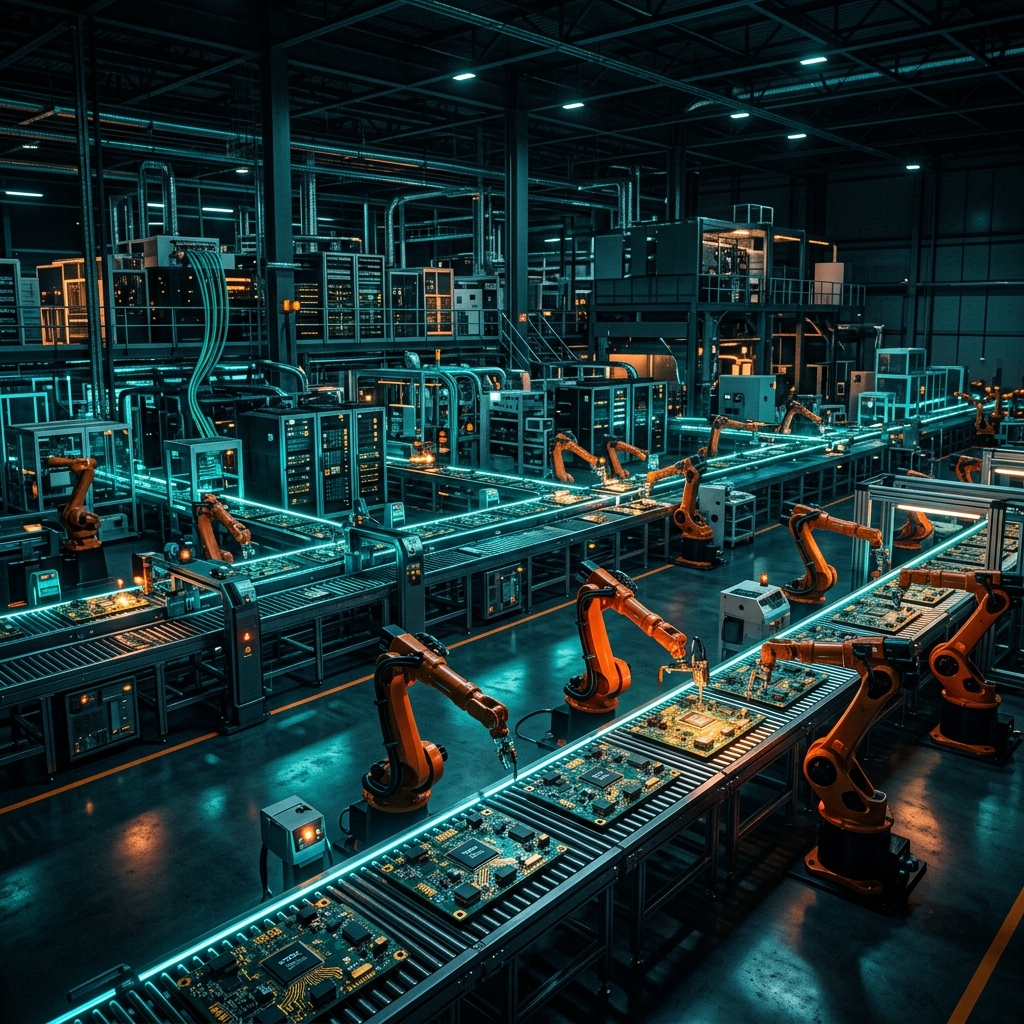
TDK Corporation, one of the world’s largest electronic component manufacturers, has announced a dramatic acceleration of its capital spending campaign — committing billions to expand production capacity for the components that underpin the global AI infrastructure boom.
The Investment Scale
| Metric | FY2026 | YoY Change |
|---|---|---|
| Capital Expenditure | ¥480B (~$3.2B) | +45% |
| R&D Spending | ¥185B (~$1.2B) | +28% |
| New Factory Construction | 3 facilities | — |
| Target Capacity Increase | +60% | By FY2028 |
The spending surge targets three critical product categories driving AI demand:
- MLCC capacitors: Essential for power management in GPU clusters and data center infrastructure
- Magnetic components: Inductors and transformers for high-efficiency power supplies
- Battery technology: Advanced energy storage for AI-powered edge devices and robotics
Why TDK Matters for AI
While headlines focus on GPUs and models, the AI revolution runs on a vast supply chain of electronic components. Every Nvidia H200 or Blackwell GPU requires thousands of passive components for power delivery, signal integrity, and thermal management. TDK is one of the critical suppliers in this chain.
Key demand drivers:
- Hyperscaler data centers: Microsoft, Google, Amazon, and Meta are all building massive AI compute facilities
- Nvidia’s production ramp: Each new GPU generation requires more power management components
- Edge AI deployment: On-device AI in phones, cars, and robots needs miniaturized, high-performance components
- EV + AI convergence: Autonomous driving systems demand ultra-reliable electronic components
The Supply Chain Bottleneck
TDK’s aggressive spending reflects a growing concern in the industry: the AI infrastructure buildout is being constrained not just by chip supply, but by the availability of the components surrounding those chips.
Industry analysts estimate that for every $1 spent on AI chips, approximately $3-5 is spent on supporting infrastructure — power supplies, cooling systems, networking equipment, and the thousands of passive components that make everything work together.
“The AI revolution doesn’t run on GPUs alone. It runs on the entire electronic ecosystem that supports them. And that ecosystem is under unprecedented strain.” — Industry analyst, Mizuho Securities
Japan’s Position in AI Infrastructure
TDK’s investment is part of a broader trend of Japanese electronics firms positioning themselves as essential suppliers to the AI buildout:
- Murata Manufacturing: Expanding MLCC and sensor production for AI applications
- Renesas Electronics: Scaling up AI-optimized microcontrollers
- Tokyo Electron: Semiconductor equipment maker seeing record orders
- Ibiden: Building new substrate factories for advanced chip packaging
The Japanese government has reinforced this trend with tax incentives for domestic AI infrastructure investment, recognizing that control of the component supply chain provides strategic leverage.
What It Means
TDK’s capital spending acceleration is a lagging indicator of AI demand — but a leading indicator of capacity expansion. The fact that component manufacturers are investing this aggressively suggests that the hyperscalers’ AI infrastructure plans are not slowing down, and that the supply chain is racing to keep up.
Source: Japan Times, Nikkei Asia, TDK Corp