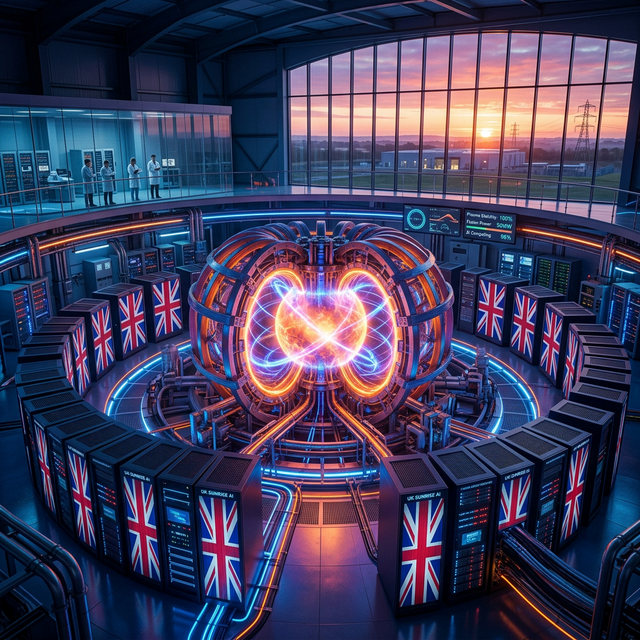
The United Kingdom has placed a significant bet at the intersection of two of the century’s most transformative technologies. The government has committed £45 million to Sunrise — a dedicated AI supercomputer designed from the ground up to accelerate fusion energy research.
What Is Sunrise?
Sunrise is the UK’s first high-performance computing system specifically built to serve fusion research. Unlike general-purpose supercomputers, its architecture and workloads are tailored for the computationally intensive simulations underpinning nuclear fusion — the process that powers stars and has tantalized energy scientists for decades.
Operation is scheduled for June 2026, placing it on the critical path for the country’s broader fusion roadmap.
Why AI and Fusion?
Fusion research involves extraordinarily complex physics — modelling plasma behaviour, optimising magnetic confinement fields, and running thousands of simulations to identify viable reactor designs. These are precisely the tasks where AI excels:
- Accelerating simulation cycles from months to hours
- Identifying patterns in plasma instability data at scales humans cannot process
- Optimising reactor parameters through reinforcement learning across vast design spaces
The THOR AI framework, recently developed by researchers at the University of New Mexico and Los Alamos National Laboratory, demonstrated that AI can solve century-old physics problems in seconds — a capability that makes Sunrise’s mandate feel achievable rather than aspirational.
Strategic Context
The investment comes as the UK competes to position itself as a hub for both AI and clean energy technologies. Fusion offers the prospect of near-limitless, low-carbon baseload power — if the engineering challenges can be solved. Sunrise is the country’s argument that AI is the accelerant needed to get there.
Source: niauk.org, sciencedaily.com