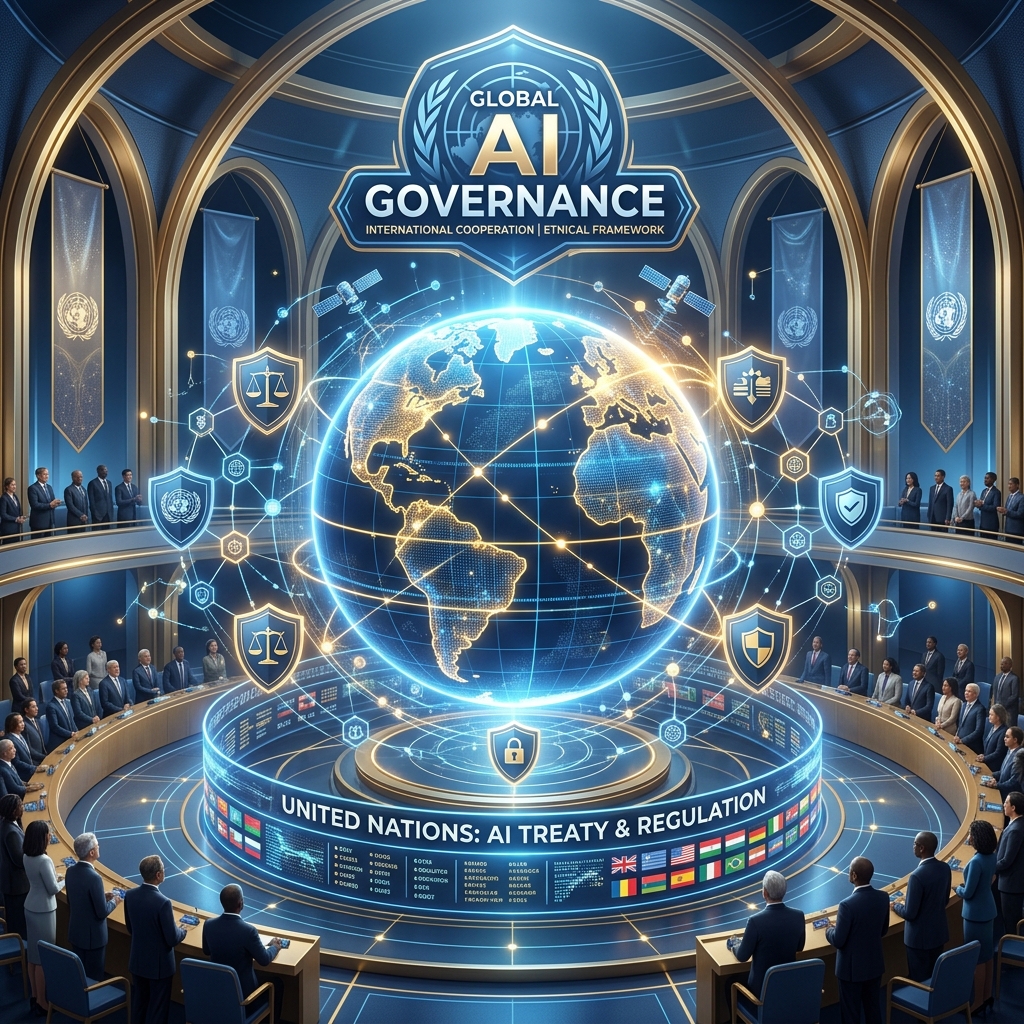
April 2026 is rapidly emerging as a “hinge month” for the future of global AI regulation. The United Nations’ Global Dialogue on Artificial Intelligence Governance has issued an urgent call, requiring all member states to submit proposals for a shared, global “operating layer” for AI rules by the end of the month.
At the center of this diplomatic scramble is a stark realization: if a unified framework isn’t established now, the global AI ecosystem will fracture into incompatible, fiercely competitive geopolitical blocs.
The Threat of Fragmentation
Currently, the world is hurtling toward a balkanized technological landscape.
- Washington and Brussels: The US and EU are focused on safety, copyright compliance, and stringent export controls on the advanced chips that power frontier AI.
- Beijing: China is prioritizing sovereign AI capabilities, rapid industrial deployment, and creating models that align strongly with state governance.
- The Global South: Emerging economies are demanding open-source access and technology transfer, arguing that stringent regulations by western nations are a new form of digital colonialism.
If these differing philosophies harden into law, deploying a global AI product could soon require three completely different foundational models tailored to regional regulations.
The Proposed “Operating Layer”
The UN initiative aims to establish an agreed-upon baseline—an “operating layer” that all AI models must adhere to, regardless of origin. Key proposals include:
- Global Registry of Frontier Models: A mandatory database detailing the training compute and capabilities of any model exceeding a specific threshold.
- Standardized Safety Red-lines: Universal agreements banning AI development in biological warfare, autonomous lethal targeting, and large-scale democratic subversion.
- Compute Tracking: International cooperation on regulating the supply chains of advanced ASICs and GPUs.
A Critical Deadline
Diplomats privately acknowledge the immense difficulty of the task. AI strategy is now synonymous with national security. With major decisions looming in the US and EU regarding semiconductor export controls—moves that directly limit adversarial AI advancement—the UN has a tiny window to forge a consensus.
As the April deadline approaches, the global tech industry waits to see whether AI will become a unifying global infrastructure or the definitive digital wall of the 21st century.