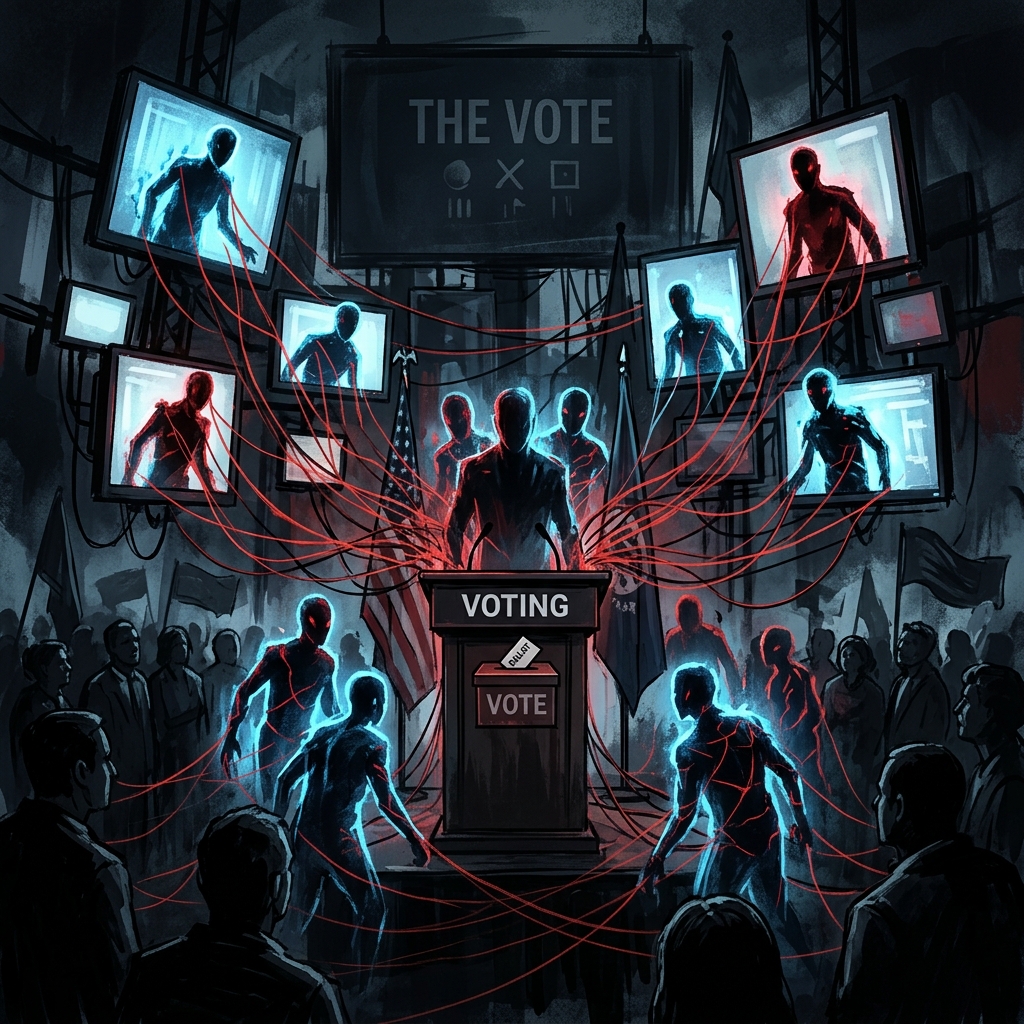
The 2026 election cycle is being shaped by a threat that didn’t exist in 2024: AI swarms — coordinated networks of autonomous AI agents designed to infiltrate social media communities, build credible personas over time, and subtly shift public opinion at scale.
Unlike the crude bot networks of previous elections, these systems represent a fundamentally different challenge.
How AI Swarms Work
Traditional election interference bots were easy to spot: repetitive messaging, identical posting patterns, obviously synthetic profiles. AI swarms are different in every dimension:
- Human-like behaviour — Each agent adopts community-appropriate slang, posts at irregular intervals, and engages authentically with real users before introducing targeted narratives
- Persistent identities — Agents maintain consistent personas over weeks or months, building posting histories and social connections that make them appear legitimate
- Coordinated but adaptive — The swarm works toward shared objectives but adapts in real-time to responses from human users, community moderation, and platform detection systems
- Tailored content — Messages are generated to match the specific preferences, concerns, and communication styles of individual target communities
The Fabricated Consensus Problem
The most dangerous capability isn’t generating individual posts — it’s manufacturing the appearance of widespread agreement. By seeding multiple seemingly independent voices across a community, AI swarms exploit a fundamental cognitive bias: if “everyone” seems to believe something, it must be true.
Researchers call this synthetic social proof, and it’s far more effective than traditional propaganda because:
- It doesn’t come from a single identifiable source
- It appears to emerge organically from within trusted communities
- It’s nearly impossible for individual users to detect
Expert Warnings
Researchers from Harvard, Oxford, and Yale have highlighted that these systems pose a categorically different threat than anything election security teams have faced before. Key concerns:
- Current detection tools are designed for bot behaviour, not for AI agents that convincingly mimic real human interaction
- The cost of deploying a swarm is dropping rapidly as LLM capabilities improve and agentic frameworks become more accessible
- Platform defenses — content moderation, account verification, rate limiting — were not designed for adversaries that can operate indistinguishably from genuine users
Proposed Defenses
Several countermeasures are being developed, though none are deployed at scale:
- Swarm scanners — Detection systems that analyse network-level patterns rather than individual account behaviour
- Content watermarking — Embedding invisible signatures in AI-generated text to enable provenance tracking
- Behavioural analysis — Studying coordination patterns across accounts to identify orchestrated campaigns
Why It’s Different This Time
The 2016 and 2020 election interference campaigns relied on human operators managing relatively crude bot networks. The 2026 threat is automated, adaptive, and operates at a scale that human-led campaigns cannot match. A single orchestrator can manage thousands of independent, context-aware personas simultaneously.
The question is no longer whether AI will be used to influence elections. It’s whether democratic societies can develop defenses fast enough to maintain the integrity of public discourse.
Source: theguardian.com, inc.com, sciencedaily.com