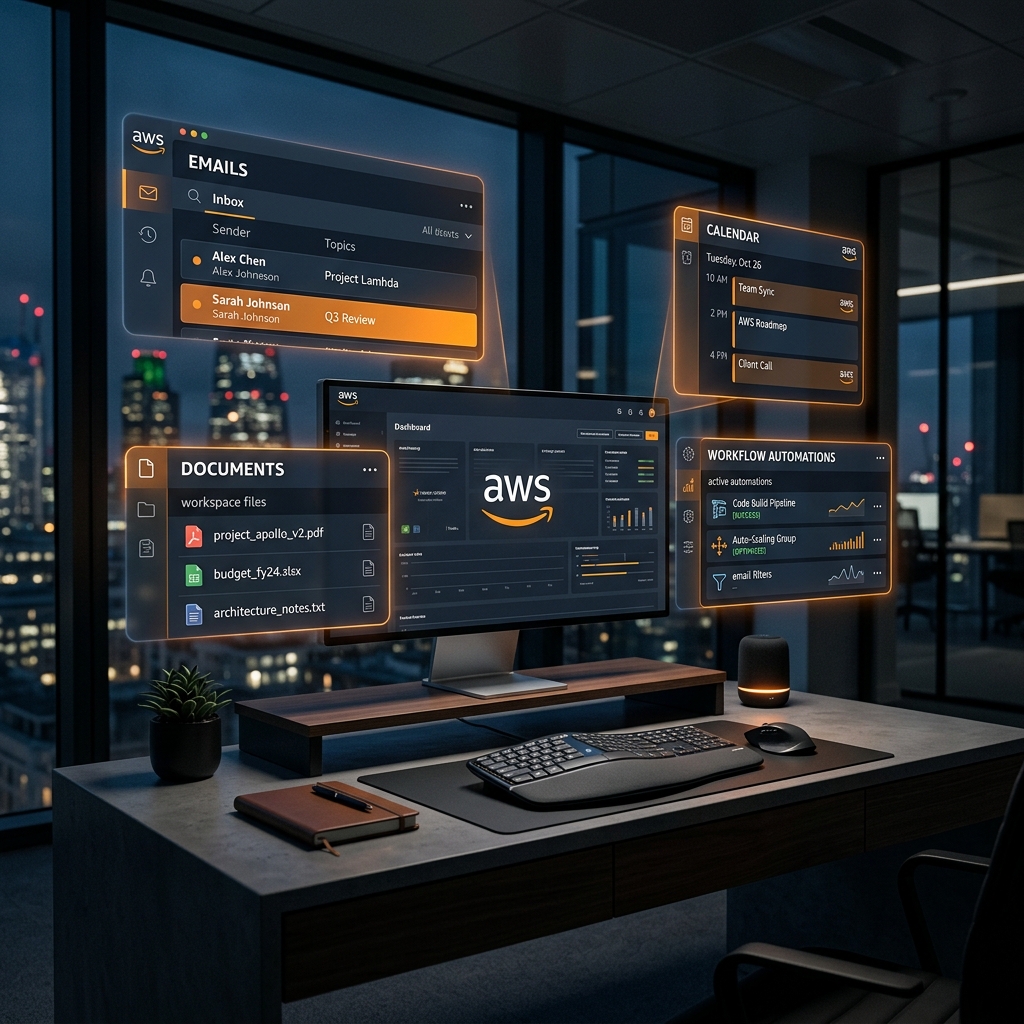
AWS has launched Amazon Quick, a desktop AI assistant that fundamentally rethinks what a personal AI companion should be. Unlike reactive chatbot interfaces, Quick runs continuously in the background, monitoring local files, emails, calendars, and third-party enterprise applications to understand and automate user workflows.
Agent-First Architecture
Quick isn’t a chatbot with a file browser bolted on. It uses an agent-first architecture that:
- Indexes documents to build a personalized knowledge graph
- Retains context across sessions, learning specific preferences and workflows
- Maps team contacts, business processes, and organizational structures
- Operates proactively, surfacing relevant information before you ask
This persistent knowledge graph is what distinguishes Quick from competitors like Microsoft Copilot or Google’s Gemini integrations — it doesn’t just respond to prompts, it anticipates needs based on accumulated workflow understanding.
Deep Enterprise Integration
Quick connects with a broad ecosystem of workplace tools out of the box:
- Google Workspace (Gmail, Docs, Drive, Calendar)
- Microsoft 365 (Outlook, Word, PowerPoint, Excel)
- Collaboration: Slack, Zoom, Asana, Jira
- CRM/Service: Salesforce, ServiceNow
- Storage: Dropbox, Airtable
- Developer Tools: Kiro CLI, Claude Code
Core Capabilities
Users can leverage Quick to:
- Generate documents, presentations, and infographics via natural language prompts
- Surface meeting preparation materials automatically from recent communications
- Draft contextual email replies based on conversation history
- Build intelligent dashboards from enterprise data sources
- Automate repetitive tasks across connected applications
Privacy and Access
Two details stand out in the launch:
- No AWS account required — Quick is accessible with just an email address, dramatically lowering the barrier to entry
- Data remains private — AWS explicitly states that data processed by Quick is not used to train external models
This positioning suggests Amazon is targeting individual knowledge workers and small teams, not just enterprise IT buyers — a strategic land-and-expand move.
Why It Matters
Amazon Quick represents AWS’s most aggressive move into the productivity AI space, directly challenging Microsoft’s Copilot ecosystem. The agent-first, knowledge-graph approach is architecturally more ambitious than simple prompt-response systems, and the no-AWS-account requirement signals Amazon’s intent to compete for the consumer-adjacent productivity market, not just enterprise infrastructure.
The question is whether users will be comfortable with a desktop agent that continuously monitors their digital activity — even with strong privacy commitments.
Source: aboutamazon.com, techradar.com, reworked.co