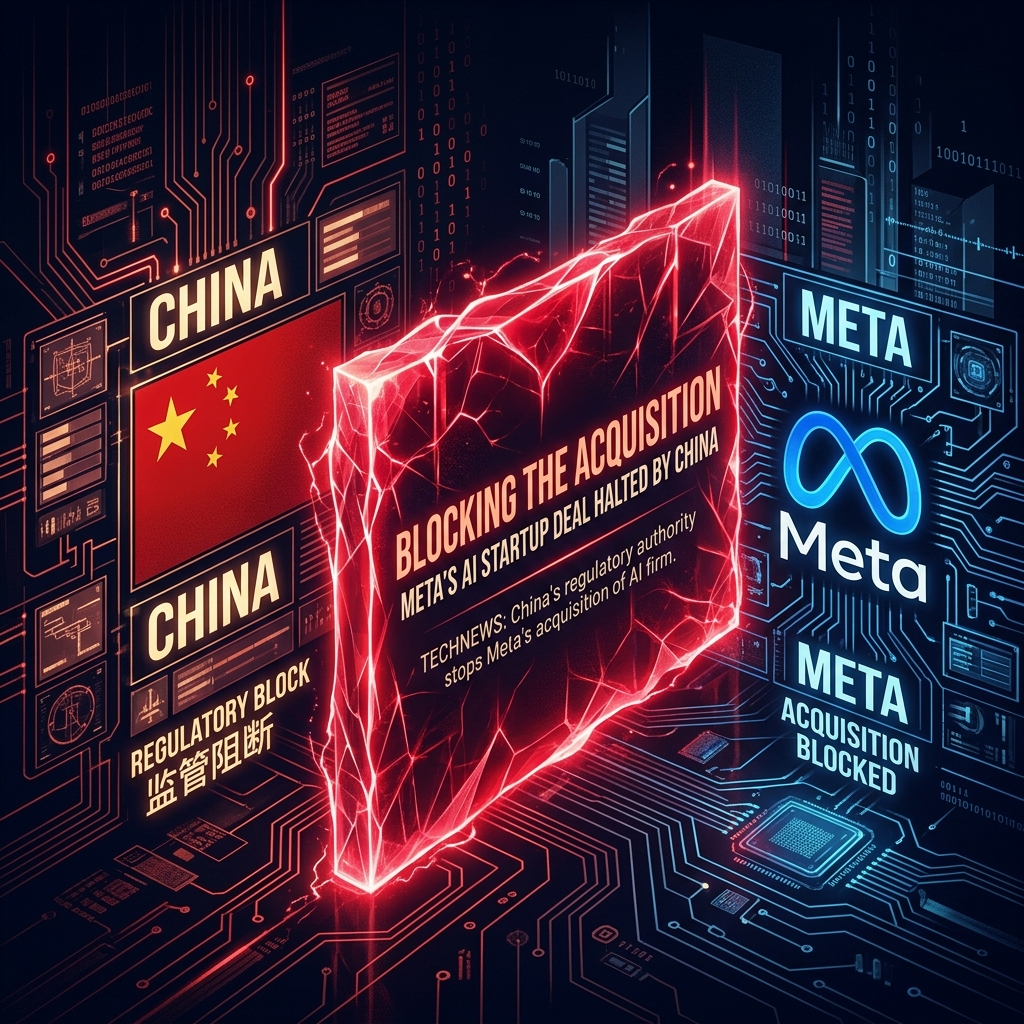
In a move that sent shockwaves through the global AI industry, China’s National Development and Reform Commission (NDRC) has formally blocked Meta’s proposed acquisition of Manus, a Beijing-based startup widely regarded as one of the most advanced developers of general-purpose AI agent technology.
Why Manus Matters
Manus has been at the forefront of autonomous AI agents — systems capable of independently planning, executing, and adapting multi-step workflows across different software environments. Unlike narrowly focused AI tools, Manus’s technology represents a leap toward truly general-purpose digital workers that can operate across arbitrary applications without custom integration.
The startup’s agent framework had drawn interest from enterprise customers across Asia and Europe, and its open research contributions had made it a rising star in the agentic AI space.
Beijing’s Rationale
The NDRC cited national security concerns and the need to protect “core technologies critical to China’s strategic AI capabilities.” Officials characterized Manus’s agentic AI framework as dual-use technology with implications for both civilian and defense applications.
The decision reflects Beijing’s broader strategy of:
- Preventing technology transfer of frontier AI capabilities to foreign competitors
- Protecting domestic AI champions from acquisition by US tech giants
- Asserting regulatory control over AI deals at a time when both nations are racing to dominate agentic AI
Industry Fallout
The blocked deal has immediate implications:
- Meta loses access to what many considered the most sophisticated agent orchestration technology outside of Google and Anthropic
- Cross-border AI M&A faces a chilling effect, with dealmakers now factoring in regulatory risk from both US and Chinese authorities
- Manus must now chart an independent path, likely accelerating partnerships within China’s domestic tech ecosystem
The Bigger Picture
This is the first time China has explicitly blocked a major US tech company’s acquisition of a Chinese AI firm. The decision mirrors actions taken by the US government through CFIUS (Committee on Foreign Investment) to block Chinese acquisitions of American AI companies — but in reverse.
The message from both governments is converging: AI talent and technology are now treated as strategic assets on par with semiconductor manufacturing and defense technology. The era of frictionless cross-border AI collaboration may be drawing to a close.
Source: wlrn.org, reuters.com