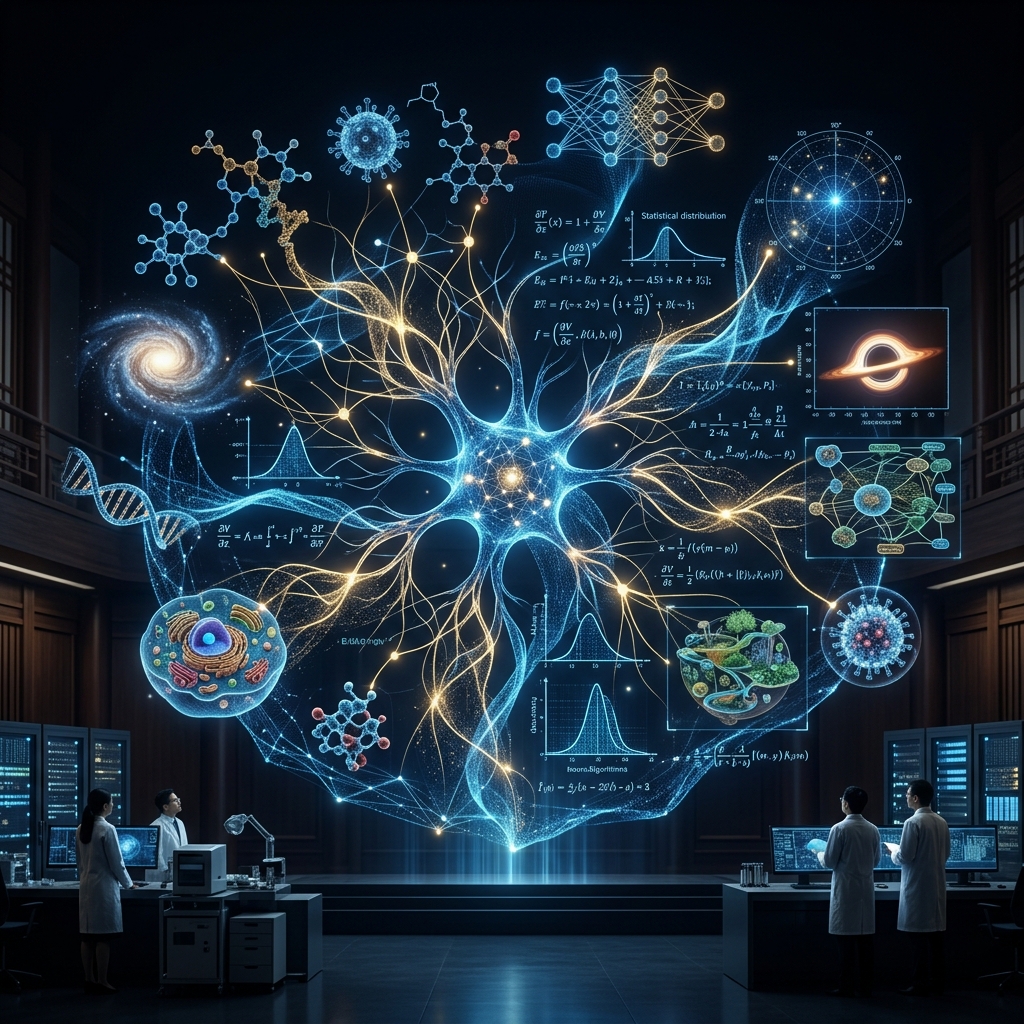
The Chinese Academy of Sciences (CAS) has unveiled ScienceOne 100, a comprehensive AI system purpose-built for scientific research. Deployed across 50+ CAS institutes and supporting over 100 research scenarios, ScienceOne 100 represents one of the most ambitious attempts to systematically apply AI across the full spectrum of scientific inquiry.
System Architecture
ScienceOne 100 builds on the original ScienceOne foundation model released in 2025, but with dramatically expanded scope and capability. The system comprises eight domain-specific large models spanning:
- Mathematics — automated theorem proving and conjecture generation
- Physics — simulation acceleration and experimental design optimization
- Materials Science — novel material property prediction and synthesis pathway planning
- Astronomy — observational data analysis and celestial event classification
- Environmental Science — climate modeling and ecological pattern recognition
- Aerospace — fluid dynamics simulation and structural optimization
- Geosciences — seismic analysis and mineral exploration
- Biology — protein structure prediction and genomic analysis
Three Core Capabilities
Literature Compass
An autonomous scientific literature system that can:
- Perform in-depth literature reviews across millions of papers
- Generate comprehensive review articles with proper citation chains
- Track emerging research frontiers and identify citation gaps
- Provide real-time research landscape analysis for any scientific domain
Innovation Evaluation
A strategic research intelligence system that:
- Identifies cutting-edge dynamics and shifts in research emphasis
- Maps key unsolved problems across scientific disciplines
- Evaluates potential innovation directions with feasibility scoring
- Benchmarks research output against global competitors
Agent Factory
An autonomous research execution platform offering:
- 2,000+ specialized research tools spanning data collection, analysis, simulation, and visualization
- Closed-loop agent pipelines that can design, execute, analyze, and iterate experiments with minimal human supervision
- Coverage across 10+ research domains with domain-specific tool libraries
- Multi-agent collaboration where specialized agents hand off work across disciplines
Real-World Deployments
ScienceOne 100 is already being used for:
- High-speed rail flow field reconstruction — modeling aerodynamic effects on China’s bullet train network
- Novel materials discovery — identifying candidates for next-generation batteries and superconductors
- Astronomical observation — processing data from FAST (Five-hundred-meter Aperture Spherical Telescope) and other observatories
- Ecological research — monitoring biodiversity changes across China’s national parks
Performance Benchmarks
CAS reports that ScienceOne 100 has achieved:
- Flagship-level performance in scientific knowledge benchmarks
- State-of-the-art results in scientific image understanding and manipulation
- Strong performance in agentic long-horizon reasoning — the ability to plan and execute multi-step research workflows autonomously
Geopolitical Context
ScienceOne 100 arrives at a moment of intensifying US-China AI competition in scientific research:
- The US has invested heavily in AI for science through programs at DOE, NSF, and DARPA
- China’s centralized research structure allows CAS to deploy AI across dozens of institutes simultaneously — a coordination advantage that decentralized Western research ecosystems struggle to match
- The system’s focus on autonomous research agents aligns with the broader global trend toward agentic AI, but applies it specifically to scientific discovery rather than commercial tasks
Why It Matters
ScienceOne 100 is not a chatbot for scientists — it’s an attempt to build autonomous research infrastructure at national scale. If CAS succeeds in making AI-driven scientific discovery routine across its 100+ institutes, the implications for global research competitiveness are profound. The question is no longer whether AI will transform science, but which nation’s AI systems will make the breakthroughs first.
Source: cas.cn, chinadaily.com.cn, bignewsnetwork.com