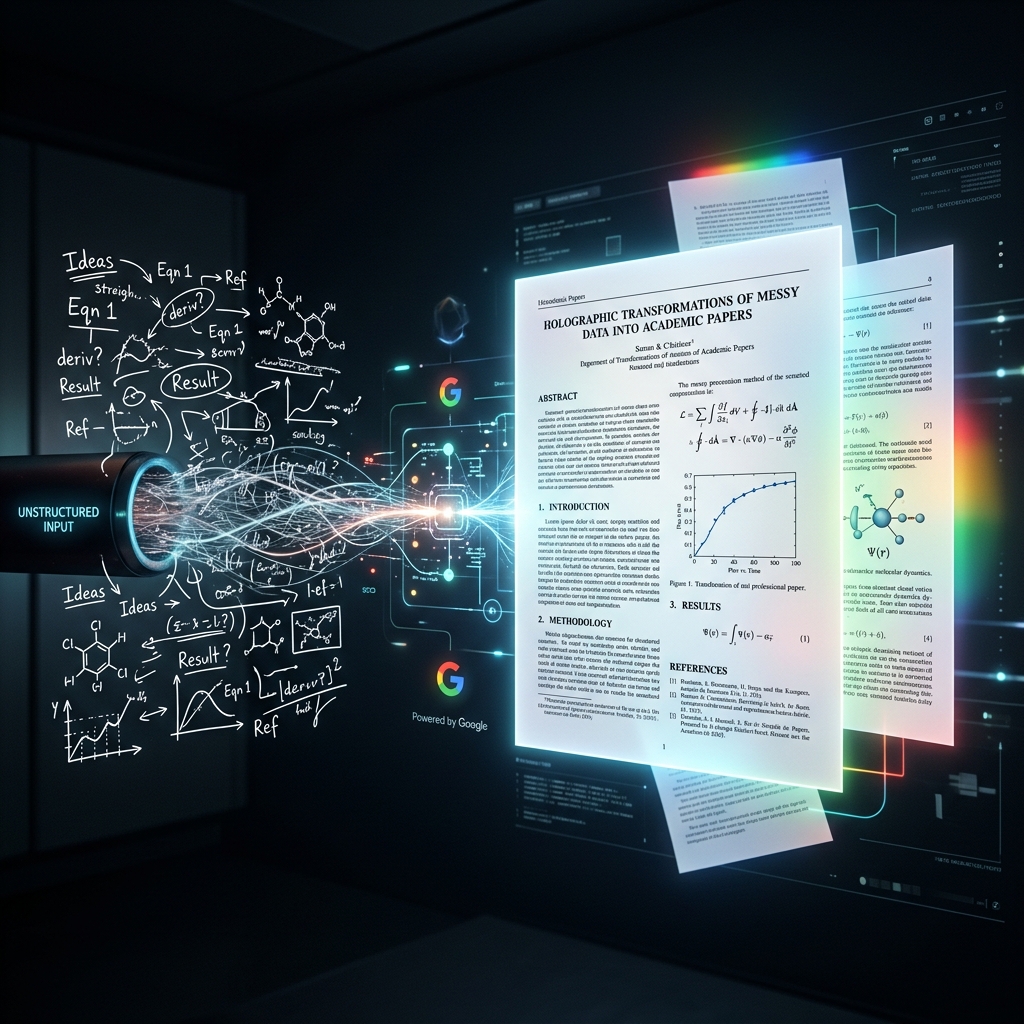
Academic research is about to undergo a tectonic acceleration. Google has unveiled PaperOrchestra, an advanced multi-agent AI framework designed specifically for the scientific community, capable of transforming unstructured data and scattered lab notes into fully formatted, submission-ready LaTeX manuscripts.
How PaperOrchestra Works
Unlike general-purpose models like Gemini or GPT that can write decent text, PaperOrchestra is a highly specialized ensemble of distinct AI agents acting in concert:
- The Data Analyst Agent: Ingests raw CSVs, spreadsheet data, and experimental logs to generate mathematically accurate charts and tables.
- The Literature Reviewer: Scours existing databases to provide comprehensive and properly cited background context.
- The LaTeX Architect: Structures the document in pristine, compile-ready LaTeX, ensuring no syntax errors or formatting bugs.
- The Reviewer/Editor: Critiques the generated manuscript for flow, logical consistency, and academic rigor.
Researchers simply drop a folder of their notes, data, and a brief audio description of their findings into the system, and PaperOrchestra generates a cohesive manuscript draft within minutes.
Eliminating the ‘Friction’ of Science
Google frames PaperOrchestra as a tool to remove the friction of academia. According to early beta testers at major universities, the tool automates up to 70% of the writing process. “It doesn’t do the science for you,” one beta tester remarked, “but it removes the grueling weeks spent formatting citations and arguing with LaTeX margins.”
Controversy in Automation
However, the tool has sparked intense debate. Academic journals are scrambling to update their policies on AI-generated submissions. While the data underlying the papers may be authentic, critics argue that the act of writing is the act of thinking.
If scientists outsource the synthesis of their ideas to PaperOrchestra, do they risk losing deep engagement with their own discoveries? And as the volume of AI-generated papers skyrockets, peer review systems—already under massive strain—may face total gridlock. Regardless of the philosophy, PaperOrchestra marks a definitive milestone in automating the scientific method.