At Hannover Messe 2026, the world’s largest industrial technology fair, the Physical AI era arrived with a tangible milestone: a humanoid robot successfully completed an autonomous 8-hour shift in a live production environment.
The Demo That Mattered
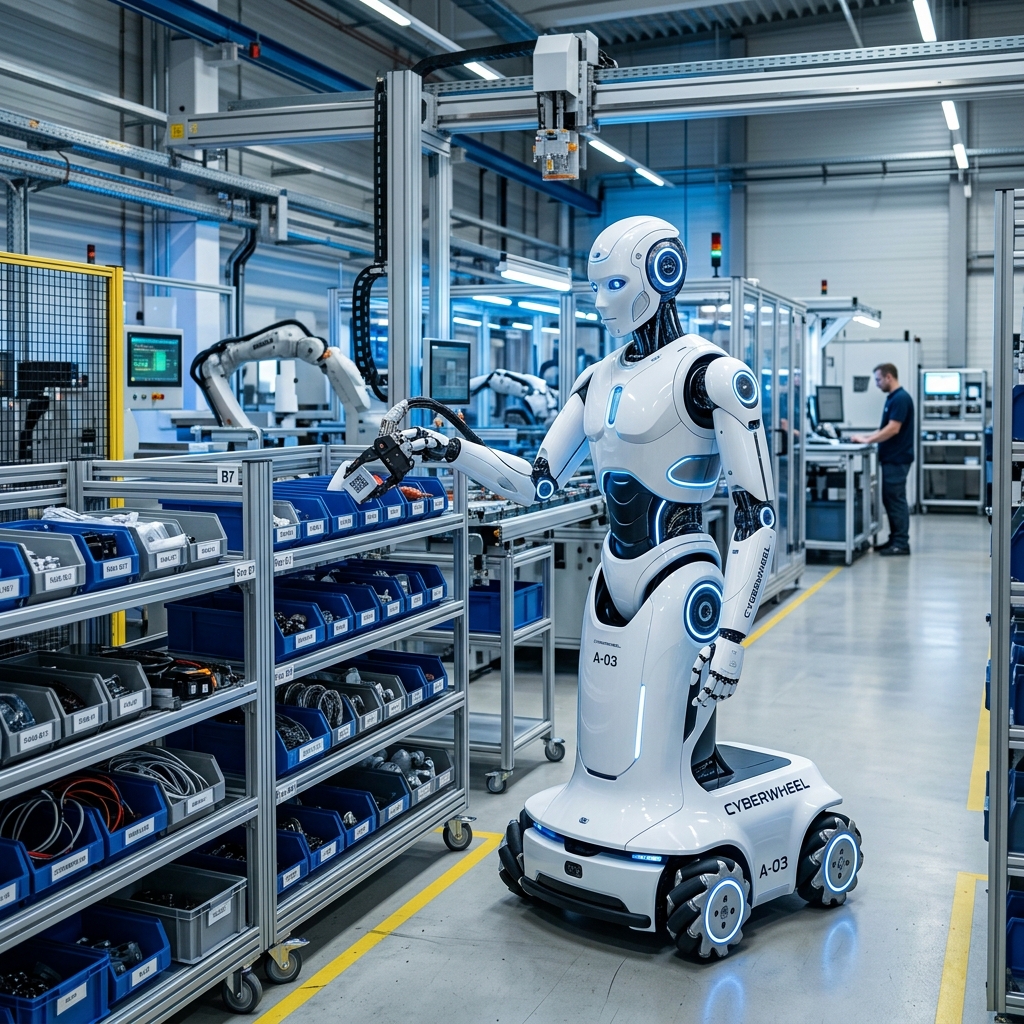
Siemens, NVIDIA, and UK-based robotics startup Humanoid demonstrated the HMND 01 Alpha — a wheeled humanoid robot — performing tote-destacking logistics operations at Siemens’ electronics factory in Erlangen, Germany.
The numbers:
- 8+ hours of continuous autonomous operation
- 60 moves per hour throughput
- >90% pick-and-place success rate
- Zero human intervention required during the shift
This wasn’t a controlled lab demo or a trade show stunt. It was a real factory, running real production workflows, with real parts on the line.
The Technology Stack
The HMND 01 Alpha runs on NVIDIA’s Physical AI stack:
- NVIDIA Jetson Thor — edge AI compute module handling on-robot perception and decision-making
- NVIDIA Isaac Sim & Isaac Lab — simulation and reinforcement learning frameworks used to train the robot’s policies
- Digital twins via Omniverse — the factory environment was replicated digitally to stress-test robot behaviour before physical deployment
The development timeline is noteworthy: using this simulation-first approach compressed prototype development from the typical 18–24 months down to approximately 7 months.
Safety-Critical Infrastructure
Also at Hannover Messe, BlackBerry’s QNX division announced an expanded partnership with NVIDIA to integrate QNX OS for Safety 8.0 with NVIDIA IGX Thor and the Halos Safety Stack. This provides a certified safety platform for industrial robotics, autonomous mobile robots (AMRs), and humanoids operating in environments alongside humans.
This is critical infrastructure: before humanoid robots can operate at scale in factories, they need safety-certified operating systems and hardware that meet industrial standards (ISO 26262, IEC 61508).
Why This Matters
The Hannover Messe demonstration crosses a threshold that the industry has been approaching for years:
- Simulation-to-reality transfer works. Policy training in Isaac Sim translated directly to real-world performance, proving that the “sim-to-real gap” can be closed for industrial logistics tasks.
- Wheeled humanoids are the near-term form factor. Legs are impressive in demos but introduce unnecessary complexity for factory floors. Wheels on a humanoid upper body is a pragmatic design choice that delivers results now.
- The economics are shifting. At 60 moves per hour with >90% accuracy over an 8-hour shift, the HMND 01 Alpha is approaching the throughput of human logistics workers — without breaks, shift changes, or fatigue.
What’s Next
NVIDIA is positioning its Physical AI stack as the foundation for adaptive manufacturing — moving from fixed automation (robotic arms bolted to assembly lines) to flexible, intelligent systems that can be redeployed across different tasks and facilities.
The next milestone will be multi-robot coordination: multiple humanoids working together on a factory floor, negotiating tasks and sharing workspace in real-time. The simulation infrastructure for this already exists — the question is how quickly it translates to production.
Source: nvidia.com, thenextweb.com, rcrwireless.com