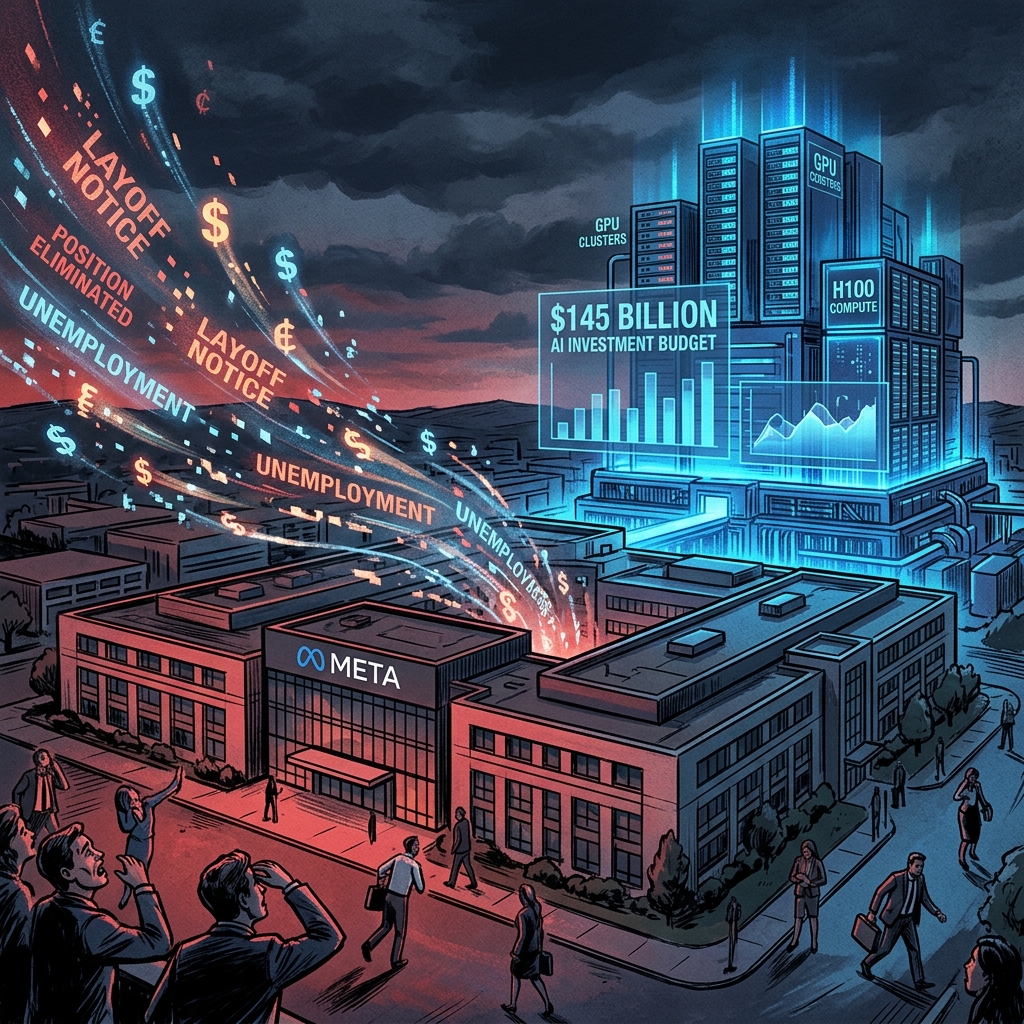
Meta is cutting approximately 8,000 jobs — roughly 10% of its workforce — in what CEO Mark Zuckerberg has explicitly framed as a capital reallocation decision: fewer people, more machines.
The Trade-Off
During a company town hall, Zuckerberg was direct about the math: “We have two major cost centers — compute infrastructure and people. If we’re investing more in one area to serve our community, then that means we have less capital to allocate to the other.”
The layoffs, scheduled to begin May 20, 2026, come alongside the elimination of approximately 6,000 unfilled positions, bringing the total headcount reduction impact to roughly 14,000 roles.
The Infrastructure Bet
In conjunction with its Q1 2026 earnings report, Meta raised its full-year capital expenditure forecast to between $125 billion and $145 billion — up from the previous range of $115–$135 billion. The spending is directed at:
- Data centers: Massive expansion of AI training and inference capacity globally
- GPUs and custom silicon: Including Meta’s custom MTIA chips and continued procurement of Nvidia hardware
- Networking infrastructure: High-bandwidth interconnects for distributed AI training
- Meta Superintelligence Labs: The company’s dedicated research division pursuing frontier AI capabilities
The Broader Context
Meta’s move is part of a broader pattern across Big Tech. Combined quarterly capital expenditure from Alphabet, Amazon, Microsoft, and Meta hit $133 billion in Q1 2026, with full-year projections reaching an estimated $725 billion across the group.
The scale of investment raises questions:
- Returns timeline: When — and whether — this infrastructure investment will generate proportional returns
- AI washing debate: Critics argue some companies are using AI as justification for layoffs that are ultimately about margin optimization
- Talent market impact: Thousands of experienced tech workers entering a job market that is simultaneously both hungry for AI specialists and shedding traditional roles
What Zuckerberg Didn’t Rule Out
Perhaps most notably, Meta leadership declined to rule out further headcount reductions later in 2026. Zuckerberg stated that the optimal long-term size of the company remains “uncertain” given how rapidly AI capabilities are evolving and automating work previously done by humans.
Why It Matters
Meta’s decision crystallizes the central tension of the AI era: companies are simultaneously investing unprecedented amounts in AI infrastructure while reducing the human workforce that built them. Whether this represents genuine technological transformation or short-term financial engineering dressed in AI rhetoric will become clearer as 2026 progresses.
The $145 billion capex figure alone exceeds the GDP of over 100 countries — a staggering concentration of capital directed at a single technological bet.
Source: tomshardware.com, theguardian.com, thenextweb.com, forbes.com