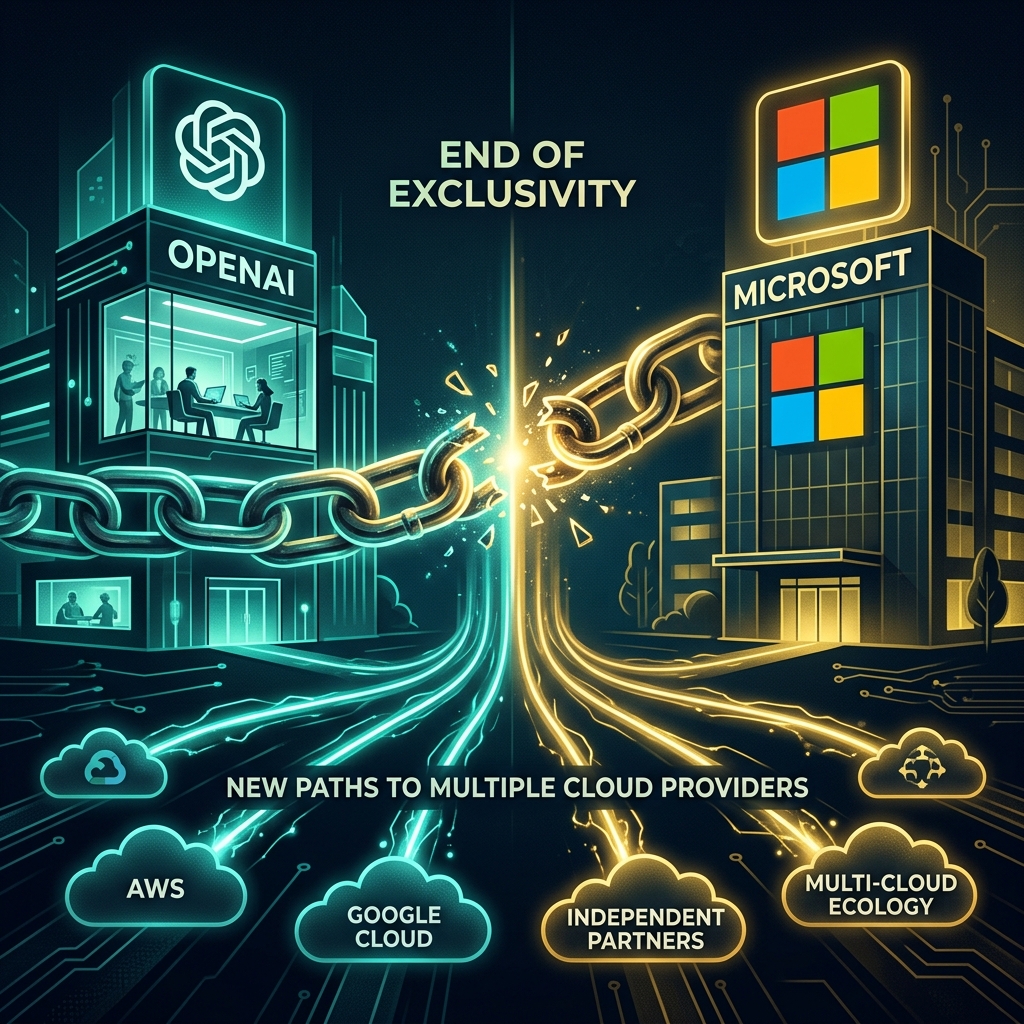
OpenAI and Microsoft have announced a sweeping amendment to their partnership agreement that fundamentally restructures the relationship that defined the modern AI era. The exclusive ties that bound OpenAI’s technology to Microsoft’s Azure cloud are being dissolved.
Key Changes
The amended agreement, announced April 27, introduces several transformative changes:
End of Exclusivity
- Microsoft’s exclusive rights to OpenAI’s intellectual property have been removed
- Microsoft retains a license to OpenAI’s models and products through 2032, but this license is now non-exclusive
- OpenAI can freely license its technology to other partners and cloud providers
Multi-Cloud Distribution
- OpenAI is now permitted to serve its products to customers across any cloud provider
- The previous Azure-only distribution model is effectively over
- Microsoft remains OpenAI’s “primary cloud partner” — new products ship first on Azure unless Microsoft is unable or chooses not to support the required capabilities
Revenue Sharing Restructured
- Microsoft will no longer pay a revenue share to OpenAI
- OpenAI continues to make revenue share payments to Microsoft through 2030, but with a total cap
- Payments are now independent of OpenAI’s technology progress milestones
Why Now
The amendment reflects the evolving strategic calculus for both companies:
- For OpenAI: Greater independence to pursue enterprise deals, government contracts, and partnerships that require cloud flexibility — critical as competitors like Anthropic and Google offer multi-cloud deployment
- For Microsoft: Reduced financial exposure while maintaining preferred access to OpenAI’s technology stack and continued collaboration on infrastructure, next-generation silicon, and cybersecurity
Market Implications
The end of exclusivity sends ripple effects across the industry:
- Cloud competition: AWS and Google Cloud can now directly offer OpenAI’s models, intensifying the three-way cloud AI battle
- Enterprise procurement: Companies previously locked into Azure for OpenAI access now have multi-cloud options
- Valuation impact: OpenAI’s ability to distribute broadly could accelerate revenue growth and strengthen its position ahead of potential IPO considerations
The Bigger Picture
This partnership amendment marks the maturation of OpenAI from a research lab dependent on a single corporate patron into an independent technology company with multi-billion-dollar revenue ambitions. Microsoft, in turn, is betting that preferred access and deep integration are more valuable than exclusivity in a rapidly commoditizing market.
The era of exclusive AI partnerships appears to be ending — replaced by a more fluid, multi-vendor landscape where AI companies seek maximum distribution and cloud providers compete on infrastructure, not lock-in.
Source: openai.com, engadget.com, geekwire.com, redmondmag.com